


The scientific name of the largest cockroach is Megaloblatta longipennis today. This giant insect holds the record for its massive wingspan. People often search for what is the scientific name of the largest cockroach. The answer always points to this remarkable South American species.
The world’s largest cockroach scientific name fascinates entomologists and nature enthusiasts alike. Megaloblatta longipennis measures over 20 centimeters in total wingspan length. This tropical rainforest dweller rarely appears in human residential areas worldwide. Scientists have studied this species extensively since its discovery in 1868.
Understanding the scientific name of the world’s largest cockroach helps researchers worldwide. This massive insect belongs to the order Blattodea like other roaches. Megaloblatta longipennis lives exclusively in South American tropical forest environments. The species plays an important role in the rainforest ecosystem nutrient recycling.
The Common Scientific Name of the Cockroach
Most household cockroaches have specific scientific names for proper biological identification. These common species invade homes and buildings across the entire globe. Scientists use Latin names to identify each cockroach species universally worldwide. The classification system helps researchers communicate effectively about different roach types.
Urban environments host several common cockroach species with distinct scientific names. Each species has unique characteristics that help experts identify it correctly. These indoor pests differ greatly from wild species like Megaloblatta longipennis. Understanding their scientific names helps in proper pest control management strategies.
Common Household Cockroach Species:
- American Cockroach appear frequently in basements and sewers everywhere
- German Cockroach infests kitchens and bathrooms in residential buildings
- Oriental Cockroach prefers damp and cool basement environments consistently
- Brown-banded Cockroach lives in warmer and drier indoor locations
| Common Name | Scientific Name | Typical Habitat |
| American Cockroach | Periplaneta americana | Sewers and basements |
| German Cockroach | Blattella germanica | Kitchens and bathrooms |
| Oriental Cockroach | Blatta orientalis | Cool damp areas |
| Brown-banded Cockroach | Supella longipalpa | Warm dry spaces |
These household species differ completely from wild giant cockroaches found naturally. Megaloblatta longipennis never invades homes or causes any indoor infestations. The giant species remains in its natural rainforest habitat throughout life. Understanding these differences helps people identify the cockroach species they encounter daily.
Largest Cockroach Biological Classification
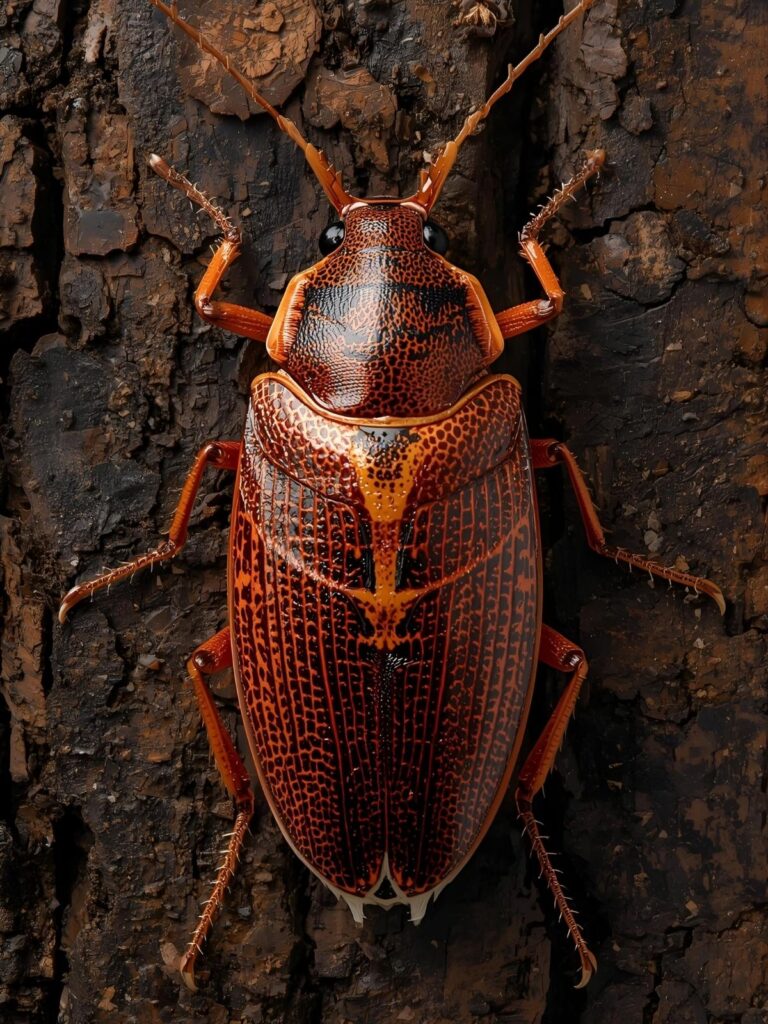
| Rank | Classification |
| Kingdom | Animalia |
| Phylum | Arthropoda |
| Class | Insecta |
| Order | Blattodea |
| Family | Ectobiidae |
| Subfamily | Nyctiborinae |
| Genus | Megaloblatta |
| Species | longipennis |
| Common Name | Giant Winged Cockroach |
The biological classification shows how Megaloblatta longipennis relates to others. This taxonomic system organizes all living organisms into specific hierarchical categories. Scientists use this system to understand evolutionary relationships between different species. The classification helps researchers study genetic connections among cockroach family members.
Megaloblatta longipennis belongs to the Ectobiidae family of cockroach species. This family includes many other large cockroach species from tropical regions. The Nyctiborinae subfamily contains several giant cockroach species from South America. Understanding taxonomy helps scientists track biodiversity in rainforest ecosystems effectively.
Where is Megaloblatta longipennis found?
Megaloblatta longipennis inhabits specific regions across South America’s tropical rainforests exclusively. The species thrives in warm and humid environments with dense vegetation. Scientists have documented this giant cockroach in several countries throughout time. The natural habitat provides perfect conditions for this nocturnal insect’s survival.
This giant cockroach prefers undisturbed rainforest areas with abundant organic matter. The species avoids human settlements and agricultural areas completely in nature. Researchers rarely encounter this shy creature during daylight hours in forests. The cockroach’s habitat continues facing threats from deforestation and development activities.
Geographic Distribution and Habitat:
- Native to Colombia’s dense tropical rainforest regions
- Found throughout Ecuador’s lowland jungle areas consistently
- Inhabits Peru’s Amazon basin rainforest zones extensively
- Lives under fallen leaves and decaying logs primarily
- Prefers areas with high humidity and warm temperatures
- Stays hidden in dark forest floor locations
How Big Is the Largest Cockroach?
The scientific name of the largest cockroach identifies an impressively sized insect. Megaloblatta longipennis showcases extraordinary physical dimensions compared to other species. This giant cockroach’s measurements continue to fascinate entomologists and researchers worldwide today. The species holds multiple size records in the insect kingdom.
| Feature | Measurement | Comparison |
| Body Length | Up to 9.7 cm | Larger than human palm width |
| Wingspan | 20 cm total | Size of dinner plate |
| Body Width | 4.5 cm | Similar to the credit card width |
| Weight | 15-20 grams | Heavier than three quarters |
| Color | Reddish-brown | Translucent wing membranes |
The massive wingspan allows this cockroach to glide between trees effectively. This unique ability distinguishes it from most other cockroach species worldwide. The large wings provide excellent maneuverability in dense rainforest canopy areas. Scientists continue studying how this species uses its wings for survival.
Life Cycle of Megaloblatta longipennis
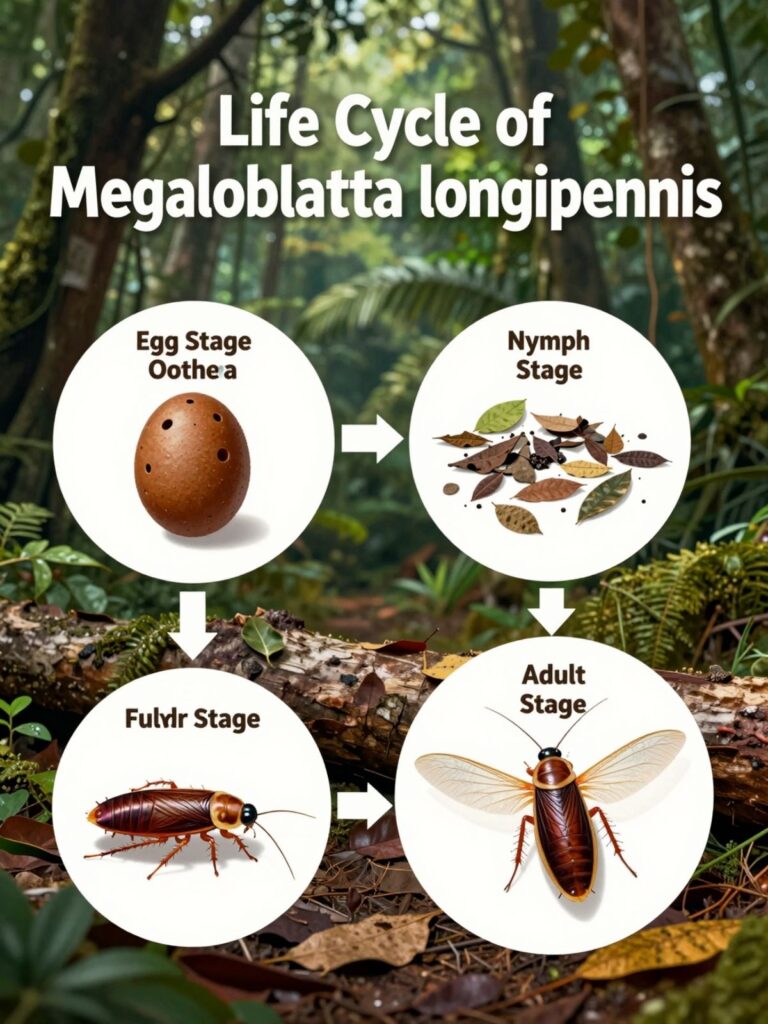
The life cycle of this giant cockroach follows three distinct developmental stages. Understanding these stages helps researchers study population dynamics in natural habitats. Each stage requires specific environmental conditions and nutritional resources for development. The entire life cycle takes several months to complete successfully.
Life Cycle Stages:
- Egg Stage (Ootheca) The female produces an egg case containing multiple eggs inside. The ootheca remains protected in hidden locations under forest debris. Eggs develop for several weeks before nymphs emerge from the capsule. Environmental conditions greatly affect the incubation period significantly.
- Nymph Stage (Multiple Instars) Young nymphs look like smaller versions of adult cockroaches initially. They molt several times while growing larger with each stage. Nymphs feed on decomposing organic matter throughout this period constantly. This stage lasts several months before reaching full adult size.
- Adult Stage (Reproductive Maturity) Adults develop full wings and reproductive capabilities after the final molt. They can glide between trees and search for mates effectively. Adults live for several months in their natural rainforest habitat. The cycle continues as adults reproduce and create new generations.
What Does the Name Megaloblatta longipennis Mean?
The scientific name of the largest cockroach describes its physical characteristics perfectly. Latin naming conventions help scientists communicate universally about species worldwide accurately. Each part of the name provides specific information about the insect. Understanding etymology reveals how scientists classify and describe new species discoveries.
Breaking down the name reveals interesting details about this giant insect. The genus and species names combine to create descriptive identification. Scientists chose these Latin terms based on the cockroach’s most notable characteristics. The naming system follows standardized international rules for biological nomenclature procedures.
Etymology Breakdown:
- Megaloblatta genus means large or giant cockroach in Latin
- Megalo prefix translates to large or great in size
- Blatta refers to the cockroach in classical Latin terminology consistently
- Longipennis species name means long-winged or extended wings
- Longus translates to long in the Latin language traditionally
- Pennis refers to wings or feathers in Latin classification
Comparison with Other Cockroach Species
Different cockroach species vary greatly in size and characteristics worldwide today. Comparing these species helps us understand the diversity within the Blattodea order. Scientists study various species to learn about evolutionary adaptations and behaviors. The following table shows how Megaloblatta longipennis compares to others.
| Cockroach Species | Scientific Name | Notable Characteristic | Maximum Size |
| Giant Winged Cockroach | Megaloblatta longipennis | Largest wingspan record | 20 cm wingspan |
| Giant Burrowing Cockroach | Macropanesthia rhinoceros | Heaviest cockroach species | 35 grams of weight |
| Central American Giant | Megaloblatta blaberoides | Similar to longipennis | 18.5 cm wingspan |
| American Cockroach | Periplaneta americana | Common household pest | 4 cm length |
| German Cockroach | Blattella germanica | Most common indoor | 1.5 cm length |
| Smallest Cockroach | Attaphila fungicola | Tiniest species known | 3 mm length |
Smallest Cockroach Scientific Name
The smallest cockroach scientific name is Attaphila fungicola in classification. This tiny species represents the opposite extreme from Megaloblatta longipennis. Scientists discovered this miniature cockroach living exclusively inside ant colonies. The size difference between the largest and smallest cockroaches amazes researchers.
Smallest Cockroach Key Facts:
- Scientific name is Attaphila fungicola in Latin classification
- Measures only 3 millimeters in total body length
- Lives symbiotically inside leafcutter ant colony nests
- Feeds primarily on fungus grown by ants
- Found across the North and Central American regions
This microscopic cockroach remains nearly invisible to the human eye. The species has adapted to survive in ant colonies successfully. Researchers study how this tiny insect coexists with aggressive ants. Understanding both extremes helps scientists appreciate cockroach diversity worldwide today.
What Does Megaloblatta longipennis Eat?
Megaloblatta longipennis feeds exclusively on decomposing organic matter in rainforests. The species plays a crucial role in nutrient recycling throughout ecosystems. These giant cockroaches break down plant material into simpler compounds naturally. Their feeding habits benefit the entire forest floor community significantly.
The diet consists entirely of dead and decaying plant materials. This cockroach avoids living plants and does not damage healthy vegetation. Scientists consider this species beneficial for maintaining forest ecosystem health overall. The feeding behavior helps speed up the decomposition process naturally.
Primary Food Sources:
- Fallen leaves in various stages of decomposition
- Rotting wood from dead trees and branches
- Fungus growing on decaying organic matter
- Dead plant material on the forest floor
- Decomposing bark from fallen logs
How to Identify Megaloblatta longipennis in the Wild
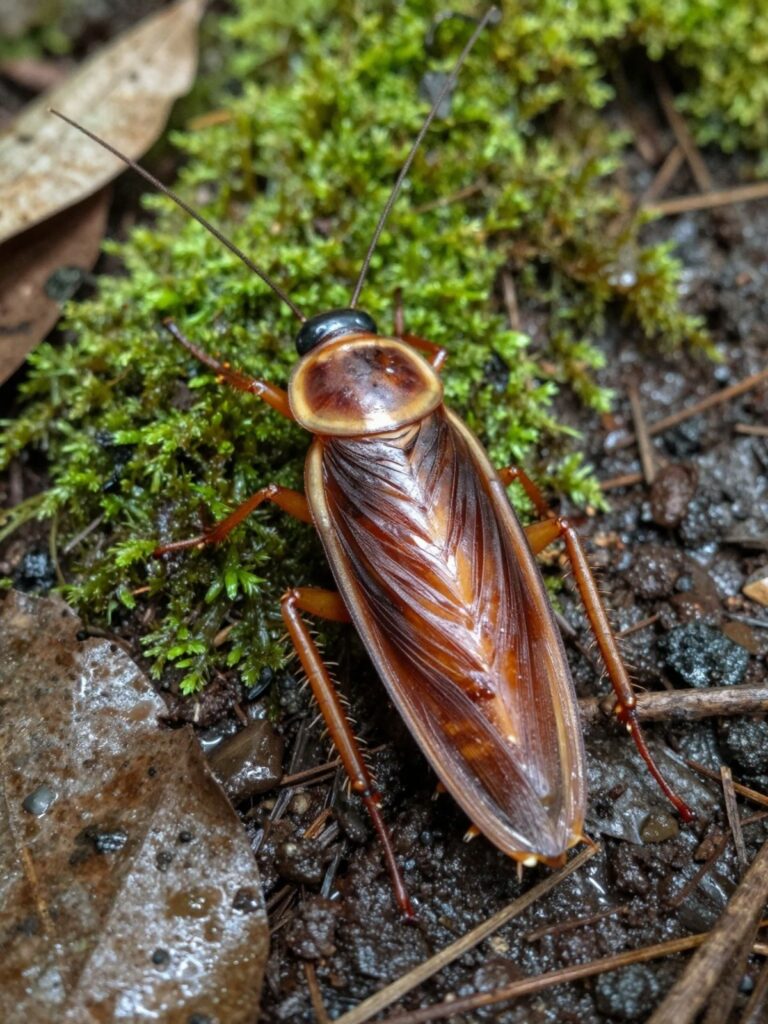
Identifying this giant cockroach requires observing several distinctive physical characteristics carefully. The species has unique features that separate it from similar species. Field researchers use specific identification markers to confirm the species correctly. Proper identification helps scientists track populations and study behavior patterns.
Identification Checklist:
- Body length measures between 8 to 10 centimeters long
- Wingspan extends up to 20 centimeters when fully spread
- Reddish-brown coloration covers the entire body surface uniformly
- Translucent wings with visible venation patterns throughout the membrane
- Large body width measuring approximately 4.5 centimeters across
- Long antennae extending forward from the head region are constantly
- Six legs with spiny segments on femur areas
- Found only in South American tropical rainforest regions
- Active during nighttime hours exclusively in the habitat
- Glides between trees rather than having sustained flying ability
Why is it Not Considered Dangerous?
What is the scientific name of the largest cockroach becomes important here. Despite its enormous size, Megaloblatta longipennis poses no threat to humans. The species lacks aggressive behavior and avoids human contact completely naturally. Scientists confirm this giant cockroach does not bite or attack people. Understanding its peaceful nature helps reduce unnecessary fear about this insect.
This cockroach species does not invade homes or infest human buildings. The giant insect remains exclusively in its natural rainforest habitat. It does not carry diseases that affect humans or domestic animals. Researchers consider this species harmless and actually beneficial for ecosystems overall.
Interesting Facts About Cockroaches
The scientific name of the world’s largest cockroach represents just one species. Cockroaches as a group showcase remarkable diversity and fascinating characteristics worldwide. These ancient insects have survived for millions of years through adaptation. Learning about cockroaches helps people appreciate their ecological importance today.
Scientists continue to discover new and interesting facts about cockroach species regularly. These insects demonstrate incredible survival abilities and unique biological features consistently. Understanding cockroaches better helps reduce common misconceptions about these creatures. The following facts highlight why cockroaches remain so successful globally.
Fascinating Cockroach Facts:
- Cockroaches existed before dinosaurs appeared on Earth, approximately
- Over 4,500 cockroach species live worldwide in various habitats
- Only 30 species commonly associate with human habitation areas
- Cockroaches can survive without their head for several weeks
- Some species can hold their breath for 40 minutes
- Megaloblatta longipennis can glide up to 30 feet distance
- Cockroaches run up to three miles per hour speed
- Female cockroaches need to mate only once for their lifetime
- Some cockroach species live up to two years
- Cockroaches communicate using chemical signals called pheromones constantly
- The giant burrowing cockroach can live 10 years naturally
- Cockroaches are more closely related to termites than beetles
Different Types of Cockroach and Their Scientific Names
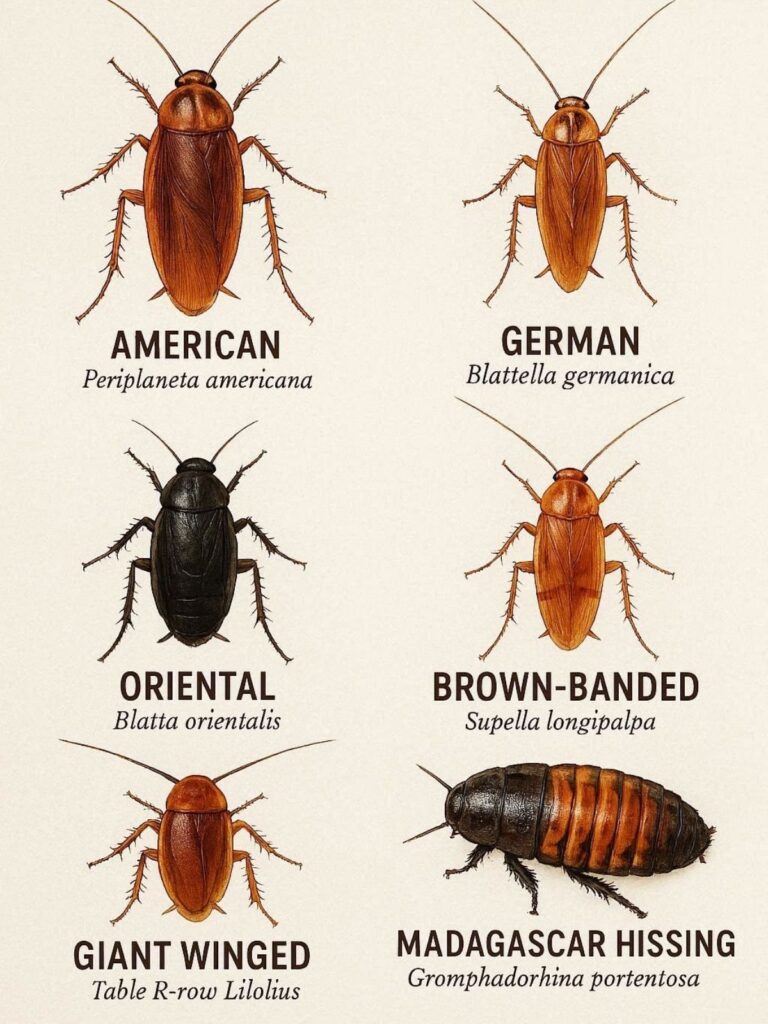
Understanding various cockroach species helps identify different types encountered worldwide. Each species has unique characteristics and preferred habitats for survival success. The scientific names provide universal identification across all languages globally. This comprehensive table shows the diversity within the cockroach family.
| Common Name | Scientific Name | Size | Habitat | Geographic Region | Distinctive Features |
| American Cockroach | Periplaneta americana | 4 cm | Indoor/Outdoor | Worldwide | Large reddish-brown pest |
| German Cockroach | Blattella germanica | 1.5 cm | Indoor | Worldwide | Most common house pest |
| Oriental Cockroach | Blatta orientalis | 2.5 cm | Damp areas | Worldwide | Dark black coloration |
| Brown-banded Cockroach | Supella longipalpa | 1.3 cm | Warm dry | Worldwide | Light brown bands |
| Smoky Brown Cockroach | Periplaneta fuliginosa | 3.5 cm | Outdoor | Southeast regions | Dark mahogany color |
| Australian Cockroach | Periplaneta australasiae | 3.5 cm | Outdoor | Tropical areas | Yellow markings present |
| Asian Cockroach | Blattella asahinai | 1.5 cm | Outdoor | Southern regions | Attracted to lights |
| Surinam Cockroach | Pycnoscelus surinamensis | 2 cm | Soil | Tropical worldwide | Burrowing species type |
| Cuban Cockroach | Panchlora nivea | 2.5 cm | Trees | Caribbean regions | Bright green coloring |
| Madagascar Hissing Cockroach | Gromphadorhina portentosa | 7.5 cm | Forest floor | Madagascar only | Produces hissing sounds |
| Turkestan Cockroach | Shelfordella lateralis | 2.5 cm | Outdoor | Central Asia | Fast running speed |
| Florida Woods Cockroach | Eurycotis floridana | 4 cm | Forest | Southeastern USA | Strong defensive odor |
| Lobster Cockroach | Nauphoeta cinerea | 2.5 cm | Various | Africa/Worldwide | Lab feeder insect |
| Death’s Head Cockroach | Blaberus craniifer | 7 cm | Forest | South America | Skull-like marking pattern |
| Giant Cave Cockroach | Blaberus giganteus | 8 cm | Caves | South America | Very large body |
| Domino Cockroach | Therea petiveriana | 3 cm | Desert | India | Black with white |
| Giant Burrowing Cockroach | Macropanesthia rhinoceros | 8 cm | Underground | Australia | Heaviest cockroach species |
| Orange-spotted Cockroach | Blaptica dubia | 4 cm | Various | South America | Popular feeder insect |
Is Megaloblatta longipennis the Largest Cockroach Ever Recorded?
The scientific name of the largest cockroach in the world is Megaloblatta longipennis. This species holds the official record for wingspan among all cockroaches. However, different measurement categories produce different record holders in classification. Understanding these distinctions helps clarify what largest actually means.
Size Category Comparisons:
- Megaloblatta longipennis has the longest wingspan at 20 centimeters
- Macropanesthia rhinoceros weighs the most at 35 grams maximum
- Megaloblatta blaberoides comes close with 18.5 centimeter wingspan
- Body length records vary considerably between these giant species.
- Megaloblatta longipennis wins for overall dimensions combined.
Last Words
What’s the scientific name of the largest cockroach remains Megaloblatta longipennis. This magnificent insect represents nature’s incredible diversity in the ecosystem. Understanding this species helps people appreciate cockroaches beyond common household pests. The giant cockroach plays a vital role in tropical rainforest environments.
The scientific name of the largest cockroach meme has spread online. Many people find this massive insect both fascinating and surprising today. Learning about Megaloblatta longipennis changes perspectives about cockroach species generally worldwide. Conservation efforts must protect these unique creatures and their habitats.
Frequently Asked Questions
What is the scientific name of the largest cockroach?
The scientific name of the largest cockroach is Megaloblatta longipennis, which holds the world record for wingspan at 20 centimeters and is native to South American tropical rainforests in Colombia, Ecuador, and Peru.
What is the scientific name of the world’s largest cockroach by weight?
While Megaloblatta longipennis has the largest wingspan, the heaviest cockroach is Macropanesthia rhinoceros from Australia, which can weigh up to 35 grams and is commonly called the giant burrowing cockroach.
Where can you find the largest cockroach in the world?
The largest cockroach Megaloblatta longipennis lives exclusively in South American tropical rainforests, specifically in Colombia, Ecuador, and Peru, where it inhabits forest floors under leaves and logs in warm, humid environments.
How big is the scientific name of the largest cockroach species?
Megaloblatta longipennis measures up to 9.7 centimeters in body length, has a wingspan reaching 20 centimeters, weighs between 15 to 20 grams, and measures 4.5 centimeters wide across its body.
What does Megaloblatta longipennis eat in the wild?
The largest cockroach feeds primarily on decomposing organic matter, including fallen leaves, rotting wood, fungus, and dead plant material, playing an essential role in nutrient recycling within tropical rainforest ecosystems.
Is the largest cockroach dangerous to humans?
No, Megaloblatta longipennis is not dangerous to humans as it does not bite, does not infest homes, does not carry diseases, and is shy and non-aggressive, preferring to avoid human contact entirely.
Can the largest cockroach fly?
Megaloblatta longipennis cannot sustain true flight but can glide up to 30 feet between trees using its massive 20-centimeter wingspan, which helps it navigate through the tropical rainforest canopy effectively.
What is the smallest cockroach scientific name?
The smallest cockroach is Attaphila fungicola, measuring only 3 millimeters in length, which lives symbiotically inside leafcutter ant colonies in North and Central America, where it feeds on fungus.
How long does the largest cockroach live?
Adult Megaloblatta longipennis typically lives for several months in its natural rainforest habitat, though the complete life cycle from egg to adult takes several months to complete through multiple nymph stages.
Why is Megaloblatta longipennis important for the ecosystem?
This giant cockroach plays a crucial role in tropical rainforest ecosystems by breaking down decomposing organic matter, recycling nutrients back into the soil, and supporting the overall health of the forest floor community.

David is a naming expert with 2 years of experience at NamesSelections.com, specializing in name meanings, team names, baby names, and unique name ideas. His insights guide readers to choose meaningful and powerful names for every occasion.